Definition of Rigging?
Construction Rigging Focuses on lifting/moving inanimate loads with slings, ropes, chains, pulleys, winches, and cranes.
Safety Rigging Focuses on lifting/moving live loads with slings, ropes, pulleys, and rated winches.
Example:
100 kg steel beam (weight ≈ 980 N)
100 kg person (weight ≈ 980 N)
The mass determines the weight in newtons; the nature of the object (animate vs. inanimate) doesn’t change the gravitational force calculation
What does all this have to do with Vector Forces?
A Vector Force (or a force vector) is the standard way forces are described in physics and mechanics.
A force is a push or pull that can change an object’s motion (speed it up, slow it down, change its direction, or deform it). What makes it a vector is that it has two key properties:
- Magnitude – how strong the force is (measured in newtons, N).
- Direction – which way the force is acting (Upward, to the right, at 45° from horizontal).
Forces have both magnitude and direction; they are classified as Vector Quantities.
Why Does This Matter?
- When multiple forces act on an object, you can’t just add their magnitudes; you add them as vectors using rules like the parallelogram law or the component method into x- and y-components, then find the resultant.
- Newton’s second law is written as ΣF = ma, where ΣF (net force) is the vector sum of all forces, m is mass (scalar), and a is acceleration (vector).
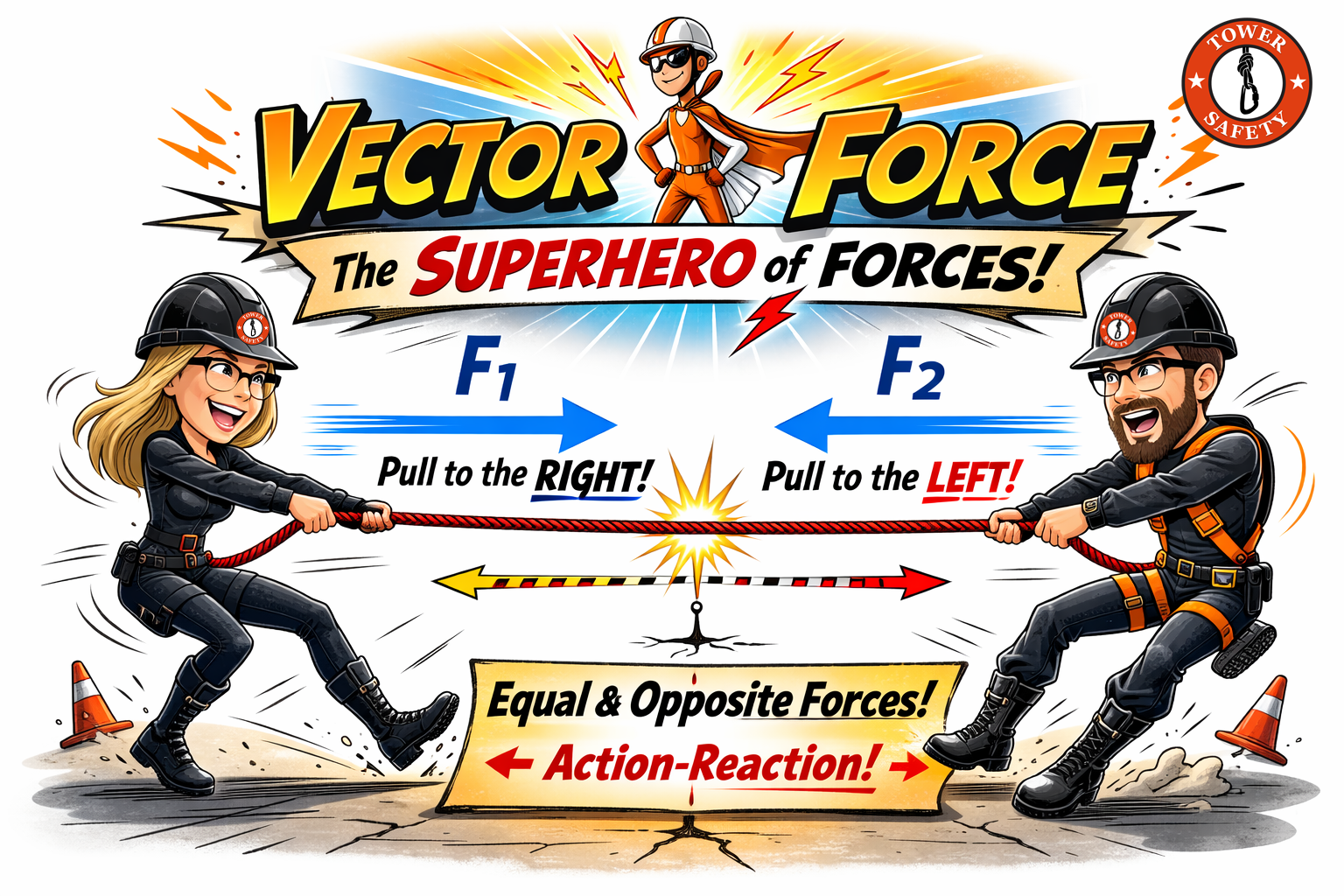
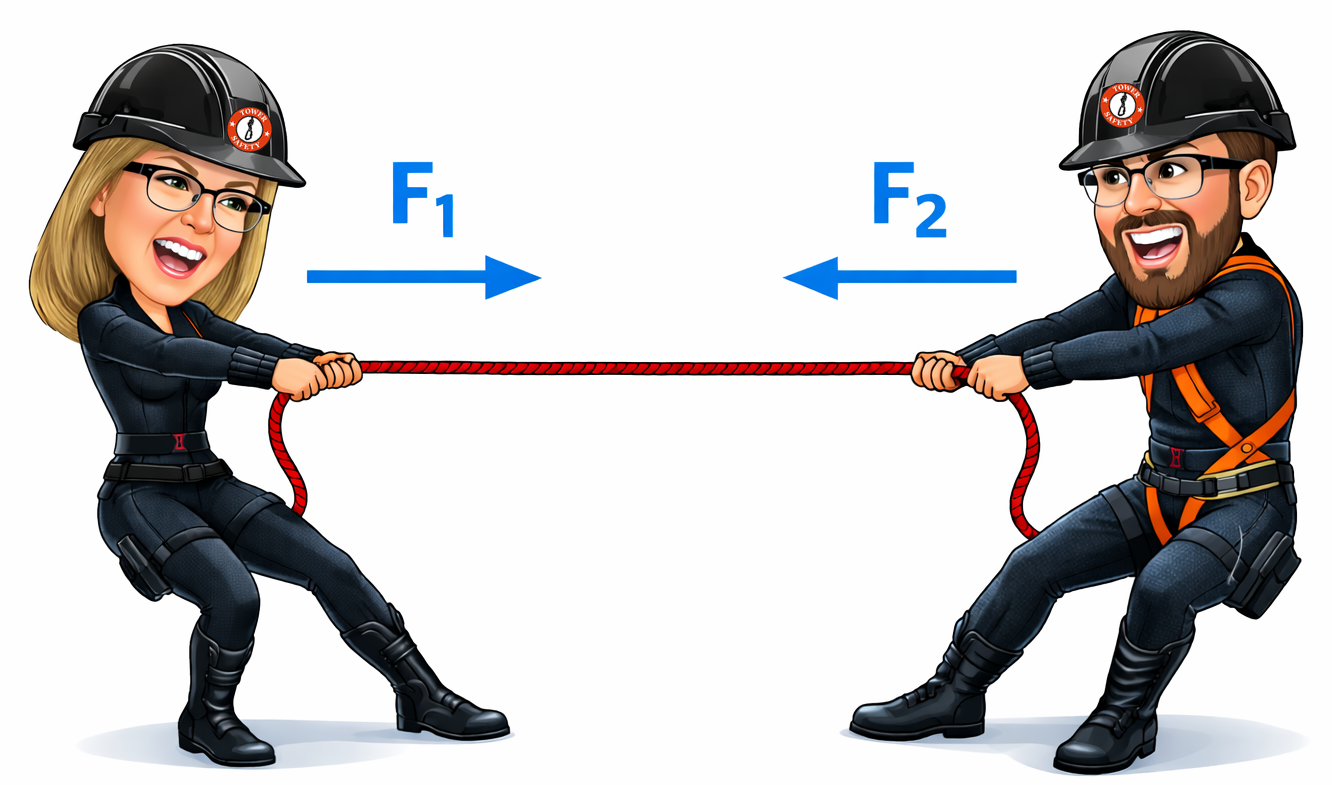
Imagine 2 people pulling on a rope in opposite directions (a tug-of-war), it creates a tension equal to the force of one person, not the sum of both
The rope experiences equal and opposite forces, placing it in a static mode, as the rope will only accelerate towards the stronger force.
- Tension: If person (F1) pulls with 100N and person (F2) pulls with 100N, the tension is 100N, not 200N.
- Newton’s Laws: Newton’s third law applies, meaning the force exerted on the rope is equal in magnitude and opposite in direction.
Every force in physics is a vector force because physics requires us to account for both magnitude and direction.