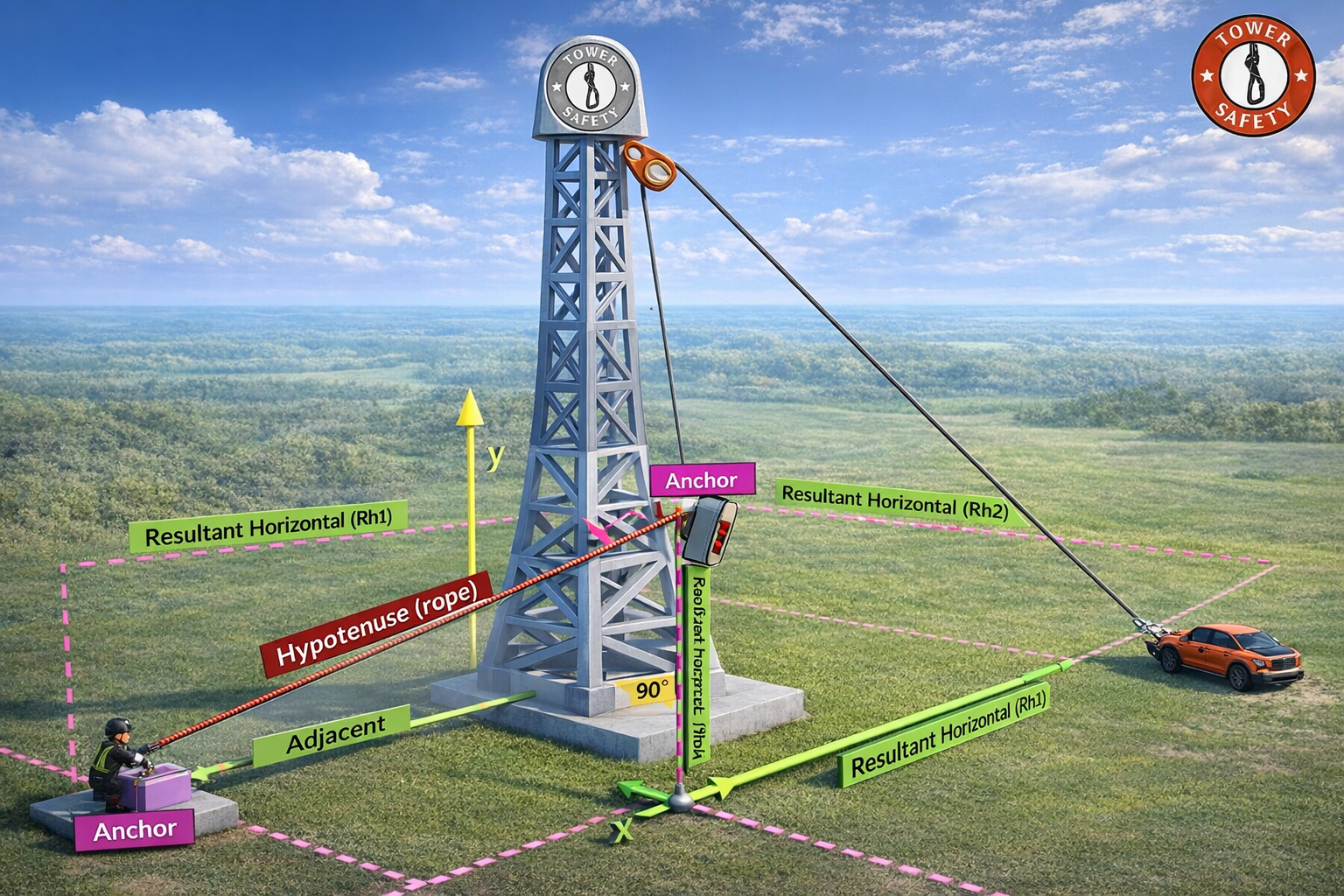
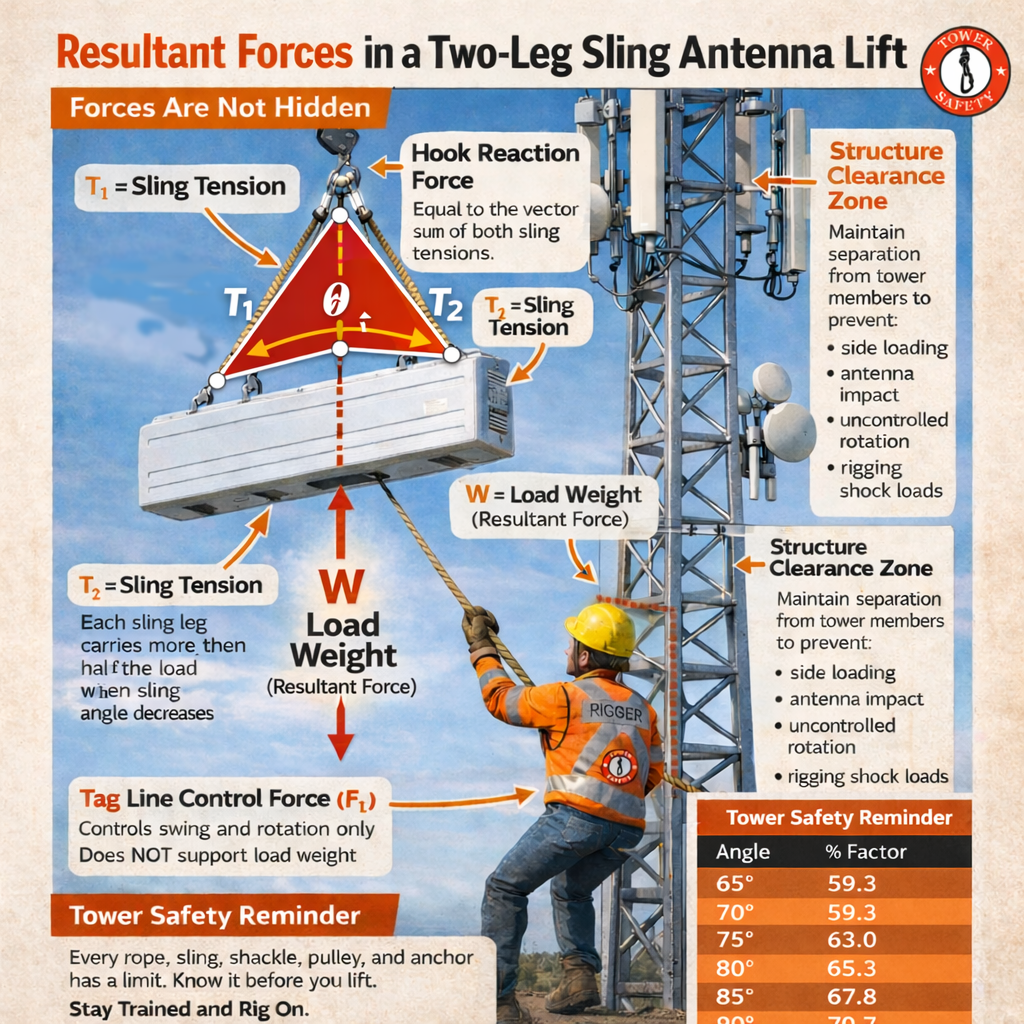
When lifting on a cell tower, you must know the total weight of the load. But the tower doesn’t “feel” weight the way we do. It feels ‘directional forces’ vectors that combine at every anchor point, pulley, and structural member. Every pulley, tag line, heel block, offset lift, or gin pole redirect creates a ‘resultant force’ that can significantly exceed the actual load weight.
Understanding vectors turns guesswork into engineered safety because we are lifting in 3 dimensions and using physics.
The Tower Sees Vectors, Not Just Weight, For Example:
- Lift a 100 lb./45kg antenna straight up vertically? The anchor sees roughly 100 lbs./45kg (plus rigging weight and dynamic factors).
- Change the rope angle with a redirect pulley, tag line, or offset? The same 100 lb. /45kg lb. load can produce:
- 140 lb./63 kg
- 173 lb./78 kg
- 200+ lb./90kg on the anchor or structure
Why? Forces are vectors.
They add geometrically, not arithmetically. The resultant is the single combined force acting on the anchor.
What Is a Resultant Force?
A resultant force is the net single force created when two or more forces (vectors) meet at a point. In tower work, this happens with the following:
- Rope passing through a pulley (two legs pulling)
- Tag lines adding horizontal control
- Heel blocks redirecting haul lines
- Offset lifts (load not perfectly vertical)
- Gin pole operations (multiple directions at tip/base)
- Static lines for positioning
Examples of Tower Rigging:
Heel Blocks/Pulleys (Highly Misunderstood):
They change direction, improve haul efficiency, and multiply anchor loading. A 100lb./63kg load through a heel block (typical ~90° redirect) can impose nearly 200lb/90kg. (or more with friction/dynamic factors) on the supporting anchor and must be calculated.
Tag Lines:
Essential for control and precise landing. A modest 25lb/11kg horizontal tag pull on a 100-lb vertical lift creates a resultant of ~103 lb. Steeper angles multiply this quickly. Uncontrolled tag tension can overload anchors, gin poles, or hardware without anyone noticing.
Gin Pole & Offset Lifts:
Rarely perfectly vertical. Multiple vectors at the head, base, and guys combine. Standards require evaluating these during planning.
Static Lines:
Great for control, but they add lateral loading that the structure must handle.
Friction Doesn’t Save You
Many assume pulley friction reduces anchor loads. It improves hauling efficiency but does not reduce the vector resultant. The anchor still sees the full combined directional forces of both rope legs. Never rely on friction for safety margins.
Why This Demands Different Anchor Evaluation
Tower members are primarily designed for:
- Vertical compression
- Tension along the main legs/bracing
- Predictable wind/ice lateral loads
Rigging introduces temporary, high-magnitude directional forces the original design may not have anticipated.
Simple Rules for Every Rigger, shifting the mindset from “it worked last time” to professional engineering awareness.
- Rope changes direction → Anchor force increases
- Second rope controls the load → Anchor force increases
- Load moves off vertical → Anchor force increases
- Always evaluate the resultant, not just the scale weight.
- Mastering resultant forces helps crews:
- Select stronger/more appropriate anchor points
- Minimize unnecessary multipliers
- Communicate clearly with ground teams
- Plan lifts with proper safety factors
Every rope, sling, pulley, carabiner, shackle, gin pole, and anchor has limits. When vectors combine, those limits are reached faster than the load weight suggests.
The load may weigh 100 lbs./63 kg, but the tower (and your anchors) always feel more.
Forces Are Not Hidden.
- Calculate them.
- Plan them.
- Respect them.
Tower Safety – Learn.Lead.Live
Always consult a qualified person/engineer for site-specific lifts and use proper dynamic factors/safety margins. Field calculations should use angle factors from recognized tables (e.g., ~1.41–2.0 for common block angles).
Stay Trained and Rig On!