Tower Safety Rigging Lab
Forces Are Not Hidden
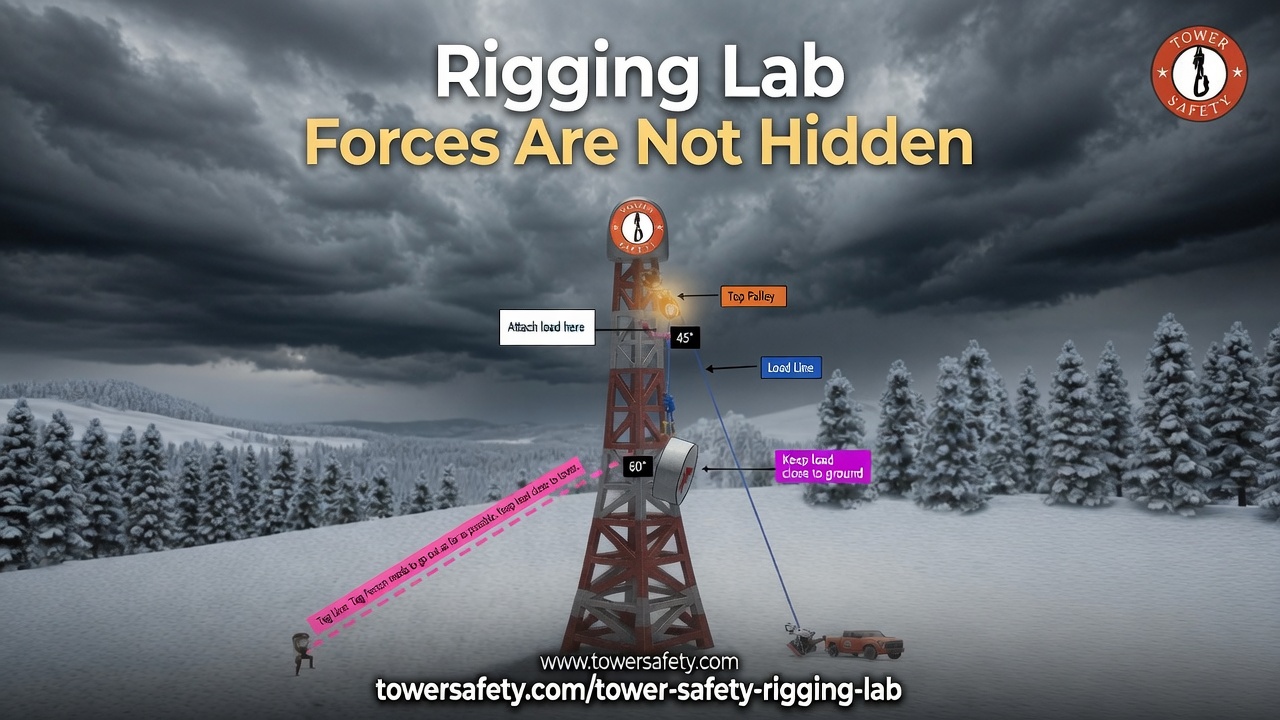
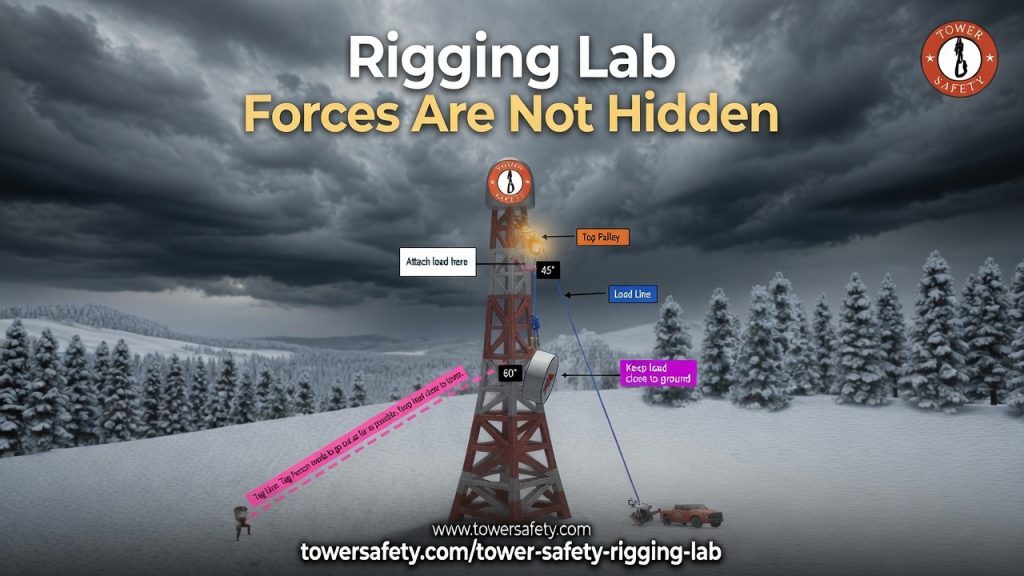
When you rig a top pulley on a tower and start lifting, most crews focus on keeping the load away from the tower. The number that actually matters to the structure, the anchor, and the hardware is the force the top block is putting into the tower and the tag person.
How to Rig A Cell Tower _ Top Pulley with Tag Line
What the Top Pulley Actually Sees
A top block pulley does two jobs at once:
- It changes the direction of the hoist line so the ground crew can pull.
The tower does not “feel” 150 lb because the antenna weighs 150 lb. The tower feels the resultant of whatever angles and tensions exist at that moment.
Add the Tag Line and Everything Changes
The moment that second rope is tensioned, you introduce another vector.
Even a modest tag line of 30 or 40 lb at an small angle adds a horizontal or diagonal component.
That is exactly what the Tower Safety Rigging Lab Top Pulley tool is built to show. Change the load. Change the height. Change the tag-line angle or the hoist-line angle. Watch the top-pulley force, the tag-line force, and the hoist-line force update in real time. The numbers stop being theoretical the second you move the sliders.
Field Reality Check
Standards and good practice require us to evaluate these forces during planning (ANSI/TIA, A10.48 mindset). The Tower Safety Rigging Lab exists so you can see them before you lift.
Simple rules that never change:
- Rope changes direction → force on the tower increases.
- Load moves off vertical → force on the tower increases.
- Always calculate the resultant, not just the scale weight.
Use the Tower Safety Rigging Lab
Go to the Top Pulley with a Tag Line page in the Tower Safety Rigging Lab.
Watch what the top block actually feels.
Forces Are Not Hidden
Learn • Lead • Live
Stay Trained and Rig On
Kathy Gill
Tower Safety